
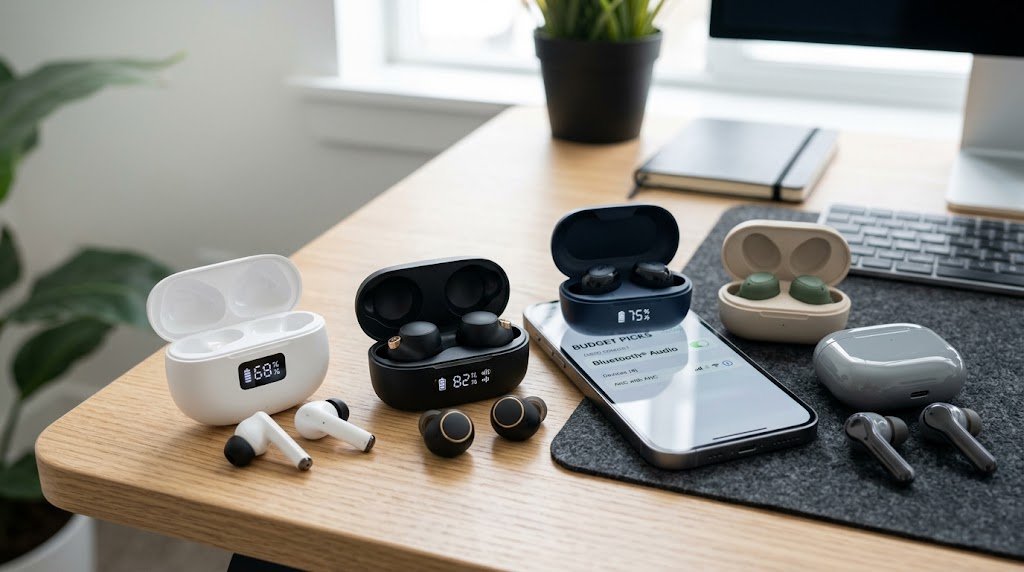
Premium wireless earbuds did not require a $250–$300 budget in 2024. Several models below $200 delivered active noise cancellation, long battery life, high-resolution codecs, multipoint connectivity, and secure everyday fit without entering flagship pricing territory.
The best wireless earbuds under 200 dollars 2024 were not all built for the same listener. Some prioritized sound tuning. Others focused on workouts, Android integration, battery endurance, or stronger noise control.
This guide uses US launch prices and typical 2024 positioning, rather than later clearance prices that can distort comparisons.
What Are the Best Wireless Earbuds Under 200 Dollars 2024?
This category covers true wireless earbuds priced below $200 in the US market during 2024 that offered enough performance to compete with more expensive models.
The strongest options included products such as the Nothing Ear, OnePlus Buds 3, Soundcore Liberty 4 NC, Beats Studio Buds+, Samsung Galaxy Buds FE, Jabra Elite 8 Active, and Google Pixel Buds Pro.
A practical buying flow looks like this:
Set Budget → Identify Primary Use → Check Phone Compatibility → Compare ANC → Check Battery → Confirm Fit and Durability → Review Codec Support → Buy
Price alone should never make the decision. A $100 pair with the right features can outperform a $190 model for a specific user.
Why Are the Best Wireless Earbuds Under 200 Dollars 2024 Important?
The sub-$200 category mattered because manufacturers were moving features once limited to flagship earbuds into much cheaper products.
- ANC became mainstream. Effective active noise cancellation appeared even around the $100 mark.
- Battery endurance improved sharply. Several models pushed combined listening time beyond 30 or even 40 hours.
- High-resolution Bluetooth expanded. LDAC and LHDC became available outside ultra-premium products.
- Better water resistance widened use cases. Fitness-focused models offered stronger sweat and dust protection.
- Apps became more capable. EQ controls, fit tests, hearing profiles, gesture customization, and ANC adjustment were increasingly common.
- Android users gained more choice. Buyers no longer needed to rely mainly on Apple-oriented products.
- Premium pricing became harder to justify. Midrange earbuds covered most everyday needs without crossing $200.
Nothing priced its 2024 Ear at $149 and Ear (a) at $99, while the Ear offered features such as high-resolution audio and advanced noise cancellation.
Quick Reference Matrix
| Core Element | Action / What It Involves | Primary Goal / Output |
| Budget | Set a hard maximum before comparing models | Avoid paying for unused features |
| ANC | Evaluate low-frequency and everyday noise control | Quieter commuting and work |
| Sound profile | Match tuning to music preference | Better listening experience |
| Codec support | Check AAC, LDAC, LHDC, SSC or SBC | Appropriate source compatibility |
| Battery | Compare buds and case separately | Reliable all-day operation |
| Fit | Review weight, tips and retention system | Comfort without constant adjustment |
| Water protection | Read the actual IP rating | Appropriate gym or outdoor use |
| Device ecosystem | Check Android, Galaxy, Pixel and iPhone functions | Fewer disabled features |
| Controls | Compare touch, pinch and physical interfaces | Faster daily operation |
| Charging | Check USB-C, fast charge and wireless charging | Easier power management |
How to Choose Wireless Earbuds Below $200
Step 1: Start With Your Main Listening Environment
Do not begin with driver size or marketing specifications. Start with where the earbuds will actually be used.
- Flights and public transportation: prioritize ANC and secure isolation.
- Office work: look for multipoint and transparent/ambient listening modes.
- Gym sessions: prioritize IP certification and stable fit.
- Long daily listening: weight and pressure matter more than extreme bass.
- Phone calls: microphone processing becomes a bigger priority than codec support.
A commuter and a runner can spend the same amount and still need completely different earbuds.
Step 2: Separate ANC From Passive Isolation
ANC and physical isolation are related, but they are not identical.
A tight silicone seal can reduce higher-frequency environmental sound before electronics do anything. ANC is generally most useful against persistent low-frequency sounds such as engines, ventilation systems, buses, and aircraft cabin noise.
Soundcore’s Liberty 4 NC used Adaptive ANC 2.0, with internal and external sensing designed to react to both the environment and the user’s ear. Soundcore marketed the system as capable of reducing noise by up to 98.5% under its test conditions.
Do not treat a manufacturer’s percentage as a universal real-world measurement. Fit, ear shape, frequency, and surroundings change the result.
Step 3: Match Bluetooth Codecs to Your Device
Codec logos matter only when the phone also supports them.
| Codec | Best Fit | Practical Note |
| AAC | iPhone and broad compatibility | Common and reliable |
| SBC | Virtually every Bluetooth device | Basic fallback codec |
| LDAC | Compatible Android phones | Higher bitrate capability |
| LHDC | Selected Android devices | High-resolution option with limited universal support |
| Samsung SSC | Compatible Galaxy devices | Best suited to Samsung’s ecosystem |
The Nothing Ear supported high-resolution playback, while the OnePlus Buds 3 supported LHDC 5.0 on compatible hardware.
Buying an earbud solely because it carries a high-resolution badge makes little sense when the phone cannot use the codec.
Step 4: Calculate Battery Life With ANC Enabled
The biggest battery number on a product page normally represents a favorable configuration. ANC, transparency mode, higher-quality codecs, volume, calls, and environmental conditions can reduce runtime.
For example, the OnePlus Buds 3 were rated for up to 10 hours from the earbuds and 44 hours with the case with ANC off using AAC. With ANC enabled under OnePlus’s stated test conditions, those figures dropped to 6.5 hours and 28 hours.
The calculation to care about is simple:
Required daily listening time ÷ realistic single-charge runtime = charging frequency
Someone listening two hours per day has very different requirements from a traveler wearing earbuds for an eight-hour flight.
Step 5: Inspect IP Ratings Instead of Reading “Workout Ready”
IP codes provide more useful information than lifestyle photographs.
The Jabra Elite 8 Active carried an IP68 rating for the earbuds, while its charging case was IP54. Jabra also designed the model around its ShakeGrip retention approach and rugged-use positioning. Its original US MSRP was $199.
That made it particularly relevant for outdoor exercise, heavy sweating, and users who routinely expose earbuds to difficult conditions.
The later Elite 8 Active Gen 2, launched in June 2024, moved above this article’s price ceiling at $229 MSRP.
Step 6: Test Ecosystem Restrictions Before Buying
Wireless earbuds may connect over standard Bluetooth while still reserving their best functions for selected devices.
Samsung’s Galaxy Buds FE, for example, supported Samsung ecosystem features including Auto Switch and SmartThings Find. Samsung listed support for SSC, AAC and SBC codecs, while several advanced functions depended on compatible Galaxy hardware.
Apple users face the same issue in reverse with some Android-focused products. Always check:
- Companion-app availability.
- Firmware-update support.
- Spatial-audio restrictions.
- Fast-pairing functions.
- Device-switching behavior.
- High-resolution codec compatibility.
Step 7: Look at Controls Before Sound Features You Rarely Use
Controls determine how often the phone needs to leave your pocket.
The OnePlus Buds 3 supported sliding touch gestures for volume adjustment. Nothing used customizable controls through its Nothing X software, while Beats used its recognizable physical-style multifunction surface.
Volume control directly on the earbuds is particularly useful during running, commuting, or desk work.
Best Models for Different Real-World Scenarios
Nothing Ear for Sound Customization
Nothing introduced its revised Ear in April 2024 at $149. The model combined the company’s transparent design with high-resolution audio support, strong app-based customization, and noise cancellation rated by Nothing at up to 45 dB.
Battery life reached a claimed 40.5 hours including the charging case under the company’s stated conditions. It suited listeners who wanted more control over tuning rather than a locked sound signature.
Best suited to: listeners who enjoy EQ adjustment, high-resolution Android playback, and detailed sound customization.
OnePlus Buds 3 for Price-to-Feature Value
The OnePlus Buds 3 launched in 2024 at $99.99 in the US, placing it well below most premium competitors.
Its feature set was unusually broad for the price: up to 49 dB claimed ANC, LHDC 5.0, dual dynamic drivers, IP55 resistance, sliding volume controls, 94 ms low-latency mode on compatible equipment, and up to 44 hours of total AAC playback with ANC disabled.
Best suited to: Android users who want maximum features close to $100.
Soundcore Liberty 4 NC for Battery and Noise Control
Soundcore launched the Liberty 4 NC at $99.99. Its combination of price, ANC functionality, and battery capacity made it one of the more aggressive value propositions in the category.
Soundcore specified 10 hours from the earbuds and 50 hours total, alongside an 11 mm driver, LDAC support, Bluetooth 5.3, multipoint connectivity, wireless charging, and IPX4 resistance.
Best suited to: commuters, travelers, and buyers who hate frequent case charging.
Beats Studio Buds+ for iPhone and Android Flexibility
The Beats Studio Buds+ carried a $169.99 price and were built to operate across both Apple and Android platforms.
Beats rated them for up to nine hours from the earbuds or 36 hours with the case with ANC and Transparency disabled. With either mode active, the figures were up to six hours and 24 hours total.
They also supported Google Fast Pair and Find My Device functions on Android alongside Apple-oriented functionality such as hands-free Siri and Find My support.
Best suited to: households or users switching between Android and Apple products.
Samsung Galaxy Buds FE for Galaxy Owners
Samsung positioned the Galaxy Buds FE at $99.99. The design used interchangeable wing tips to help improve stability.
Samsung rated playback at up to 8.5 hours from the earbuds and 30 hours total with ANC disabled, or six hours and 21 hours with ANC active. The earbuds carried an IPX2 rating.
Best suited to: Samsung Galaxy users who value ecosystem integration over advanced cross-platform codec support.
Jabra Elite 8 Active for Training and Outdoor Use
The first-generation Elite 8 Active entered the market at $199 MSRP, right at the upper edge of this budget.
Jabra specified IP68 protection, an IP54 case, Adaptive Hybrid ANC, six-microphone call technology, Dolby Audio, ShakeGrip, and up to eight hours of listening time with as much as 32 hours through the case.
Best suited to: runners, gym users, cyclists, hikers, and buyers who place durability ahead of minimum price.
Google Pixel Buds Pro for Pixel-Focused Features
Google’s original Pixel Buds Pro remained a $199.99-class product around the 2024 period. Google offered ANC, multipoint connectivity and wireless charging, with battery life rated at up to 31 hours under its stated conditions.
Google also expanded the model through software, including features tied more closely to Pixel devices and Chromebooks.
Best suited to: Pixel owners wanting tighter Google hardware integration.
Direct Comparison Matrix
| Factor | Budget-Value Models | Near-$200 Models |
| Typical 2024 price band | Roughly $99–$150 | Roughly $169–$199 |
| Purchasing approach | Feature-per-dollar focused | Fit, ecosystem or specialist use |
| Replacement cost | Easier to absorb if lost | More expensive per missing bud |
| Experimentation | Better for trying new brands | Better for buyers with established preferences |
| Accessory expectations | Functional cases and tips | More attention to finish and ergonomics |
| Upgrade logic | Replace when meaningful technology changes | Keep longer if fit remains excellent |
| Target buyer | Value-driven general user | User solving a specific problem |
Price did not automatically predict sound quality in 2024. A cheaper model could make more sense when its feature set aligned better with the phone and listening environment.
Common Mistakes & Best Practices
Common Mistakes to Avoid
- Buying by driver size alone. A larger driver does not automatically produce more accurate sound.
- Treating manufacturer ANC ratings as standardized comparisons. Testing methods differ.
- Ignoring replacement-tip availability. Unusual tip designs can become annoying years later.
- Assuming every Android feature works on every Android phone. Manufacturer-specific integrations remain common.
- Using microphone samples recorded indoors as proof of outdoor call performance. Wind changes everything.
- Paying extra for spatial audio without compatible content. Some listeners rarely use it.
- Confusing water resistance with waterproof charging cases. Earbud and case ratings often differ.
How to Maximize Efficiency / Best Practices
- Save two EQ profiles. Keep one for music and another for podcasts or spoken content.
- Run the fit test after changing tips. A different seal can alter bass and ANC substantially.
- Keep firmware updated. Earbud manufacturers regularly adjust connectivity, controls, and processing.
- Use mono listening strategically. Alternating earbuds can extend practical availability during long workdays.
- Clean microphone openings carefully. Debris can hurt call performance before it noticeably affects music.
- Keep high-bitrate codecs for intentional listening. Standard codecs may consume less power during background listening.
- Photograph the serial number after purchase. Tiny case labels can become difficult to read after months of use.
Future and Modern Trends
The best wireless earbuds under 200 dollars 2024 also showed where the wider market was heading.
Adaptive audio processing was becoming more dynamic. ANC systems increasingly reacted to the listener’s environment instead of operating at one fixed intensity.
Bluetooth LE Audio and LC3 were positioned to expand over subsequent product generations. Their importance extends beyond raw audio quality because the standard supports more flexible wireless-audio applications.
Cases were also beginning to do more. Jabra’s 2024 Elite 8 Active Gen 2, although above the $200 ceiling, introduced a smart case capable of taking audio from USB-C or 3.5 mm sources and transmitting it wirelessly to the earbuds.
Software became another competitive layer. Personalized hearing profiles, adaptive EQ, location tools, cross-device handoff, accessibility functions, and assistant integration increasingly separated products built from otherwise similar Bluetooth hardware.
Battery numbers will keep improving, but repairability and long-term battery degradation remain unresolved weaknesses of tiny sealed true-wireless products.
Practical Buying Checklist
Use this checklist before placing an order:
- US price is genuinely below $200, not dependent on an unrealistic trade-in.
- Replacement ear tips are readily obtainable.
- The companion app supports your phone.
- Your device supports the advertised high-quality codec.
- The charging connector matches the cables you already carry.
- Earbud weight looks suitable for extended sessions.
- The case fits comfortably in the pocket or bag you normally use.
- Left and right earbuds can operate independently if that matters to you.
- Warranty coverage comes from an authorized seller.
- Return policy allows enough time to identify fit problems.
- Microphone quality has been checked in conditions similar to your own use.
- The IP rating matches the amount of rain, sweat, or dust you expect.
Final Thoughts
The best wireless earbuds under 200 dollars 2024 proved that the most expensive option was no longer automatically the sensible option. Around $100–$150, buyers could already get meaningful ANC, strong battery life, capable mobile apps, and high-quality wireless audio.
Choose around your phone, your ears, and your daily environment. Sound specifications look impressive on a product page, but fit, controls, battery behavior, and compatibility determine whether earbuds remain enjoyable six months after purchase.
Frequently Asked Questions – FAQs
What were the best wireless earbuds under 200 dollars 2024 for Android?
Models such as the Nothing Ear, OnePlus Buds 3, Soundcore Liberty 4 NC, Galaxy Buds FE, and Pixel Buds Pro offered strong Android-oriented functionality. The right choice depended on whether the priority was high-resolution codecs, Galaxy integration, Pixel features, ANC, or price.
Were AirPods Pro 2 under $200 in 2024?
Their official pricing sat above this guide’s normal sub-$200 threshold, although retailer promotions periodically pushed them below $200. A sale price and a standard price should be treated separately when building an evergreen comparison.
Are $100 wireless earbuds good enough for everyday use?
Yes. Models such as the OnePlus Buds 3, Liberty 4 NC and Galaxy Buds FE showed that ANC and long battery life were already accessible around $100 in 2024.
The trade-offs were usually found in ecosystem features, materials, microphone consistency, charging options, or specialized audio functions.
How long should true wireless earbuds last before replacement?
Physical lifespan varies heavily with battery cycles, moisture exposure, charging habits, and usage. Lithium-ion batteries gradually lose capacity, so an otherwise functional pair may eventually become inconvenient because of reduced runtime.
Does LDAC automatically sound better than AAC?
No. Codec capability is only one part of the audio chain. Recording quality, tuning, fit, DSP, Bluetooth conditions, source hardware, and hearing ability can have a larger practical impact.
Should I buy earbuds with wireless charging?
Wireless charging is useful when charging pads are already part of your desk or bedside setup. It has little value for someone who already charges every device through USB-C and wants the lowest purchase price.
Is ANC safe to use all day?
ANC itself does not require turning music louder and can sometimes make lower listening levels comfortable in noisy places. Safe listening still depends mainly on volume and exposure duration, not on whether noise cancellation is active.






Leave a Reply